
Marion Previous Residents by Era
Marion previous residents are documented in layers, not in one unified index. Begin with the newest transfer when the question concerns a house, then use the older source that fits the period. Property documents establish a title trail. Directories and phonebooks can place listed residents or businesses at an address. Census, newspapers, and vital-record microfilm add household or life-event context. The table separates the documented coverage from assumptions about a particular address.
| Source | Years It Covers | Where Held | What It Shows |
|---|---|---|---|
| Recorder historical documents | Online start not published; research leads from 1821 | Recorder, historic books, FamilySearch catalog | Title and legal-description chain |
| Early deed abstracts | 1821-1832 | FamilySearch catalog | Grantor, grantee, book/page, dates, and sometimes consideration or description |
| Library directories and phonebooks | 1915-2022 | Marion Public Library paper and microfilm | Person, business, address, and street comparisons |
| Selected directory leads | 1860; selected 1901-1936 | MAGS-linked collections | Checks before or between Library volumes |
| Federal census | 1790-1950 released nationally | NARA and genealogy repositories | Household composition on the census date |
| Marion Star microfilm | 1878-2019 | Marion Public Library | Moves, construction, sales, notices, and obituaries |
The Library also has vital-record microfilm for marriages from 1824-1964 and births and deaths from 1867 forward. Those records can supply a date or relationship clue, while the proper custodian remains the route for a certified current copy. A departure from an address may be explained by a sale, a death notice, or a probate matter, but no one source proves every change.
Marion Past Residents Start With a Parcel
Use the Marion County Auditor Property Search to resolve the current street address to a parcel or PIN. The address route takes house number, direction abbreviation, street name, and street type. Preserve the situs address, PIN, legal description, subdivision or lot details, owner fields, transfer information, and any deed volume, page, or file reference shown on the property card. A tax-roll mailing address is only where correspondence goes. It may be a post office box, a business, an agent, or another property.
The Marion County Recorder is the next custodian once the parcel is anchored. Its office and historical-resource links are useful entry points for a title question, but the address and legal description remain the durable connection when names repeat or an old street form differs.
The Recorder office is where an online result can be checked against the recorded document and older paper or book material.
Note: Keep the cardinal direction exactly as recorded when moving between the Auditor, GIS, city request, and deed records.
Marion Previous Residents Deed Chain
A deed trail answers who held an interest in the parcel, not necessarily who occupied it. In the Recorder AVA Records Search, start with the present owner as grantee and use the transfer clue from the Auditor. The last transfer names a grantor, the seller. Search that seller as grantee to find the earlier acquisition, then confirm the same legal description before adding the predecessor to the chronology. AVA also supports address/legal, parcel, subdivision, municipality, and tract criteria when a party name is common.
- Resolve the Marion address in the Auditor record and save the PIN, situs address, legal description, and latest transfer reference.
- Find the current owner's acquisition in AVA, noting the document number, type, recorded date, parties, and legal fields.
- Read the grantor on that transfer, then search that party as a grantee for the earlier acquisition.
- Match the legal description, lot, subdivision, or parcel detail before treating another same-name result as the same property.
- Repeat backwards, carrying both document date and recorded date because they are not the same event.
- When the online result is insufficient, use the Recorder counter, historic books or indices, and the written paid-copy route.
- Grantor
- The party transferring an interest in a recorded document.
- Grantee
- The party receiving that interest. A prior owner is often found by searching a later seller as grantee.
- Chain of title
- The ordered series of documents connecting one parcel interest to an earlier one.
- Legal description
- The lot, subdivision, map, or survey wording that identifies land more reliably than a changing street address.
Marion Recorder Access for Past Residents
The Recorder's public notice does not publish a first online year. Do not turn the absence of a stated start date into a claim about what AVA contains. Its search results can identify a document and party trail, but the office says a person who needs copies or certified copies must visit in person or send a written request with payment. Historic deed books and indices remain an important fallback for a Marion address chronology.
The Recorder records-search notice shows the official online-search channel and its verification warning.
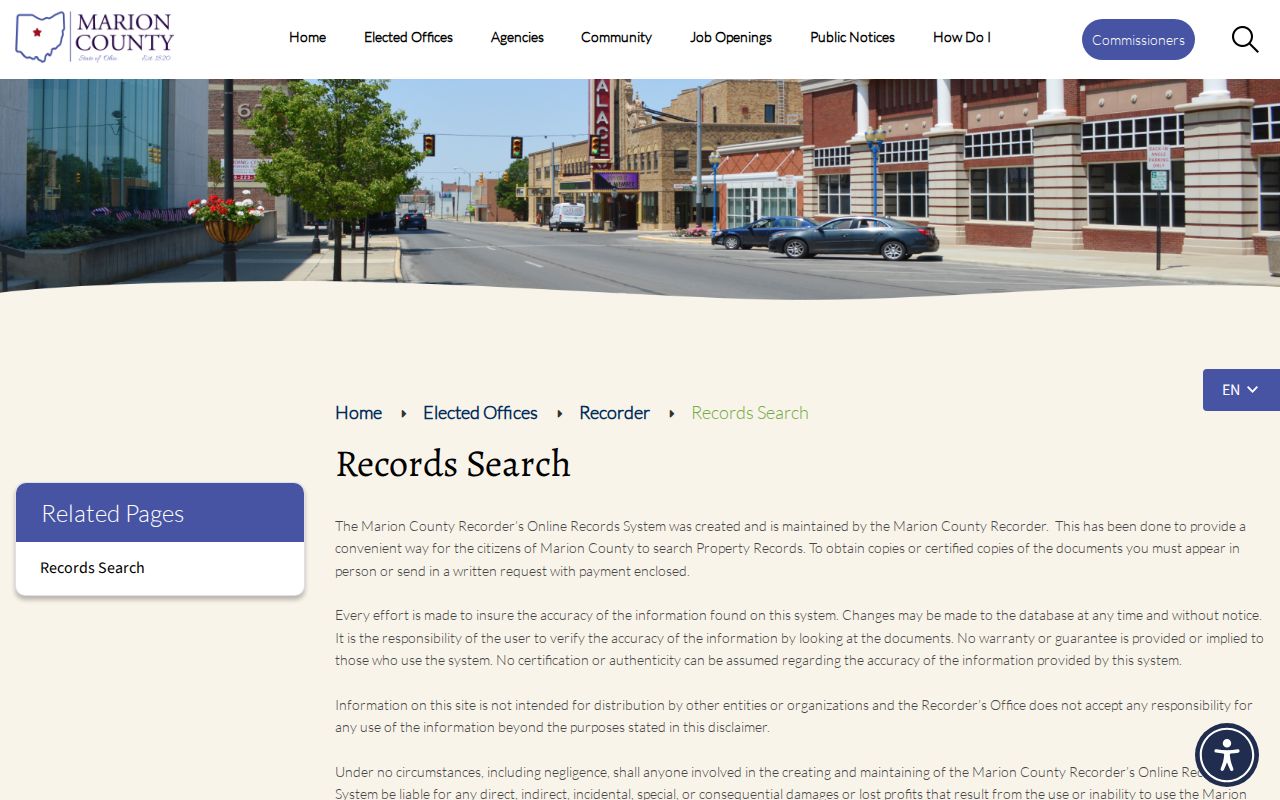
This screen supports an index search, while the counter or a written paid request remains necessary when a certified document is needed.
Marion Past Residents Before 1833
For the earliest land period, the FamilySearch catalog identifies Early deed abstracts of Marion County, Ohio, books one through four, 1821-1832. The abstracts are indexed by book and page, signing and recording dates, and grantor and grantee. Some entries also preserve consideration, a description, or witnesses. That makes them a bridge between a later parcel trail and the beginning of county-era deed research.
Research leads also identify Marion County deeds from 1821-1937 and an index to deeds from 1821-1954. Use the abstract as a lead, then reconcile it with a Recorder book or other custodian material when the legal description matters. A document involving the same surname is not enough; land wording and the sequence of transfers must agree.
Marion Past Residents in Directories
Property ownership is only one part of a household history. The Marion Public Library Family Ties guide documents directories and phonebooks from 1915-2022 in paper and microfilm. It says volumes list Marion residents and businesses by address and business type, organized chronologically and by publisher. Check the relevant volume before expecting a reverse or criss-cross format. Address order is collection-dependent, and a gap does not prove that a household moved.
- Choose the directory year closest to the transfer or census period being studied.
- Search the name, including initials and spelling variants, and copy exactly what that volume prints.
- Use an address or street section only when the selected volume supplies one, then record nearby entries for context.
- Compare the next and previous available years, keeping the publisher and year with each note.
- Pair the directory change with the deed date, a census household, or a newspaper item before drawing a conclusion.
Selected online directory leads include 1860 and particular years from 1901-1936, while the Farm Journal Illustrated Directory supplies 1918-1923 county and road-map context. The collections themselves are described in the Marion city directories section.
Marion Past Residents in Census Records
Use a directory year near a census decade, then test the address and household against the released federal census. The most recent public federal census is 1950 under the 72-year release rule. NARA's census access guidance explains the release framework. Census evidence records a household on its census date, not a complete list of everyone who ever used the address.
The Library's Marion Star microfilm runs from October 8, 1878 through December 2019. A notice can explain a sale, construction, move, obituary, or local business address. The Library's obituary cards, covering 1985-2009, are an additional surname route. Pair a newspaper clue with a dated deed, directory entry, or census record rather than treating a mention as proof of residence.
Marion Address Permits for Past Residents
Permit material can date a physical change at an address even when it does not identify a complete household. Marion's commercial Building Department keeps its records by Certified Address or a consecutive certified-address range, not by the owner mailing address. Include the cardinal direction and PID in a request. The permit material can identify an application or permit number, project address, issue or approval date, plans, inspections, and finalization.
The City public-record request information is a route to ask for specific address material. No verified online city permit or code-enforcement ledger was located. For Certified Address questions, the documented contact route is City Engineering at 740-387-2240, so an address-specific request is more dependable than a broad name search.
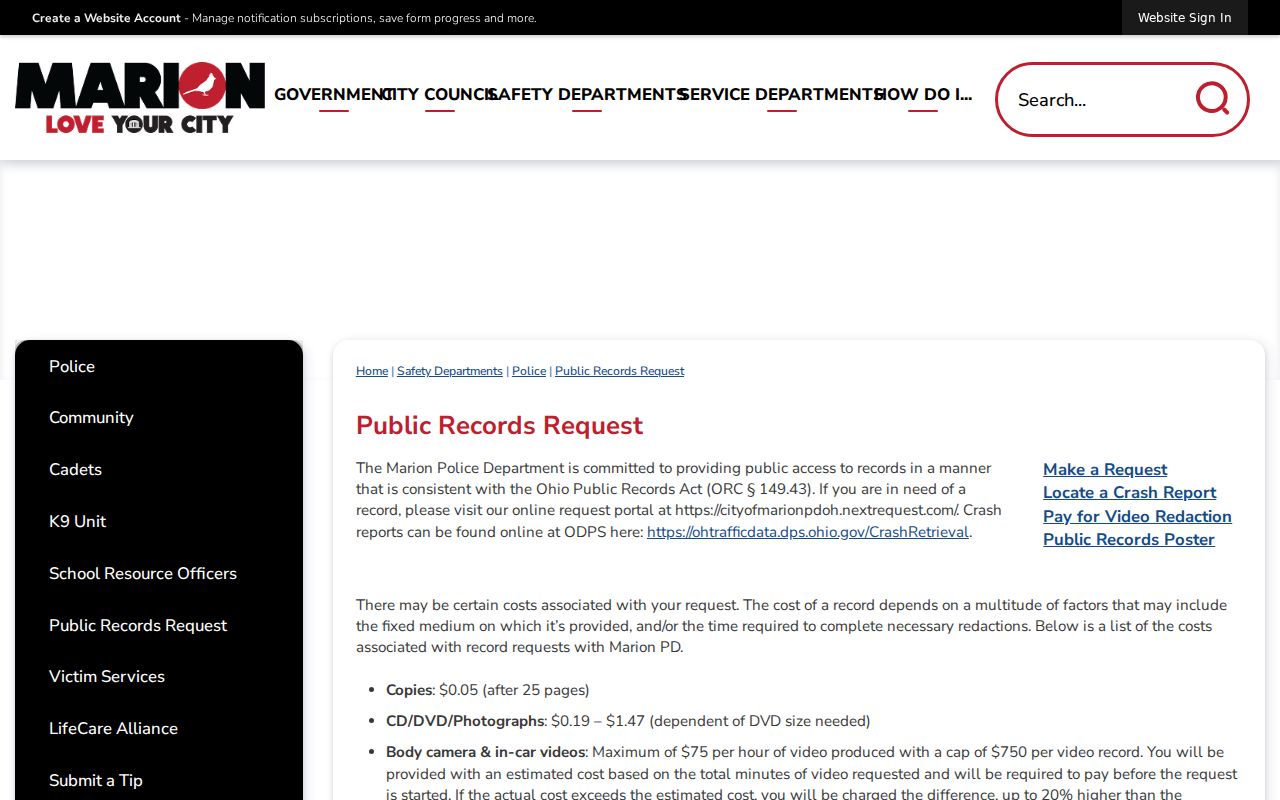
City request procedures support a focused Certified Address or PID inquiry when the online property trail does not include permit files.
Note: A permit may date work on a parcel without establishing who lived there at the time.
Marion Past Residents and Legal Endpoints
A death notice, probate matter, or foreclosure case can explain why the ownership or household trail changes. The Marion County Clerk of Courts Legal Division is the custodian for Common Pleas legal records and title work, while Probate and Family matters are held through their separate court functions. Start with a known case, document, date, or party rather than assuming a court record will list every former occupant.
The Clerk Legal Division is a documented office channel for legal-record questions and title work.
The Clerk's office is a separate record route from the Recorder and should be used only when the issue is tied to a court or title record in its custody.
Marion Previous Residents Need Proof
Historic addresses may be altered, duplicated, renamed, vacated, or affected by boundary changes. Marion research did not identify a verified citywide renumbering year, so do not assume one. No specific Marion Sanborn sheet or year was verified either. Confirm an exact map title and sheet through the Library of Congress catalog, Library staff, the Marion County Historical Society, MAGS, or Ohio History Connection before using a fire-insurance map as evidence.
Ohio's Public Records Act guidance describes the R.C. 149.43 request route when a custodian holds a record not available in an index. Ask the office for a defined parcel, address, PID, document, and time period. Inspecting a public record is different from asserting what it proves.